
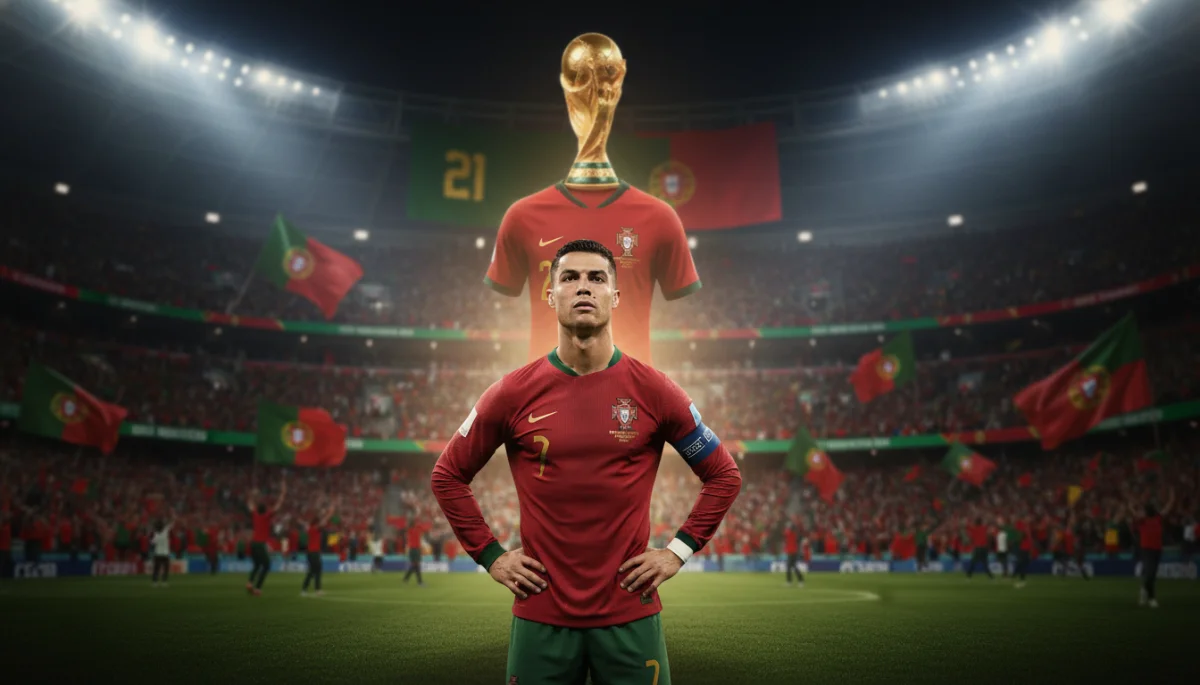
Portugal’s latest World Cup squad announcement blends ambition, emotion, and a sense of history. Cristiano Ronaldo has been included again as he prepares for what could become a sixth appearance on football’s biggest stage, while Roberto Martínez and his staff are also carrying the memory of Diogo Jota into the tournament.
The selection has drawn attention not only because of Ronaldo’s continued presence, but also because of the symbolic way Portugal has chosen to honor Jota. Martínez made it clear that the forward’s influence will remain part of the team’s identity, even though he can no longer be there in person.
Ronaldo Still Leads the Spotlight
At 41, Ronaldo remains the most recognizable figure in the Portugal setup and one of the most watched players in the world. If he takes the field at this World Cup, he will join a tiny group of men to appear in six different editions of the competition. That achievement alone would deepen a legacy that already stands among the most decorated in international football.
Ronaldo’s record book is already overflowing. He is the leading scorer in men’s international football, the player with the most appearances, and the only man to score in five separate World Cups. Even after so many milestones, his selection shows that Portugal still sees him as a decisive part of the team’s competitive identity.
Martínez has not kept him in the squad merely out of sentiment. The coach continues to value Ronaldo’s authority in the dressing room, his ability to rise in major moments, and the confidence he gives teammates when pressure increases.
A Squad Shaped by Loss and Purpose
The emotional center of Portugal’s announcement was Diogo Jota. The former Liverpool and Portugal forward died in a car crash in Spain last year at the age of 28, leaving a powerful void in the national team and across the wider football community. Martínez’s tribute was heartfelt, describing Jota as Portugal’s “plus one forever.”
Portugal is limited to a 26-player tournament roster, yet the symbolic way the squad was framed made room for one more presence in spirit. Jota’s memory is expected to travel with the team throughout the competition, turning grief into motivation and giving the group an added emotional edge.
For several players, especially those who knew him well, the tournament will be about more than results. It will also be about carrying a teammate’s legacy with dignity and focus.
Depth Across Every Line
Portugal enters the tournament with one of the most balanced groups in the field. Martínez has selected a mix of veteran leaders, midfield technicians, aggressive full-backs, and dynamic attackers, giving the squad several ways to shape matches. The team’s strength lies not only in star names, but in how comfortably those names fit together.
In goal, Diogo Costa heads the group, supported by José Sá, Rui Silva, and Ricardo Velho. Costa is expected to remain the first choice, while Velho’s inclusion offers extra cover should injuries or other issues arise.
Defensively, Portugal can rely on Rúben Dias as a central anchor, with João Cancelo, Diogo Dalot, and Nuno Mendes providing width and attacking thrust from the flanks. Nélson Semedo, Gonçalo Inácio, Renato Veiga, Tomás Araújo, and Matheus Nunes add even more flexibility, giving Martínez the option to vary shape without losing quality.
The midfield may be Portugal’s most complete unit. Bruno Fernandes and Bernardo Silva offer creativity, leadership, and experience in advanced roles, while Vitinha and João Neves bring control and composure. Rúben Neves and Samú Costa add balance and physical presence, making it easier for Portugal to adapt to different opponents and game states.
Up front, the attack is as dangerous as ever. Ronaldo remains the central figure, but Portugal can also turn to Rafael Leão’s pace, João Félix’s skill, Gonçalo Ramos’s directness, Pedro Neto’s speed, Francisco Conceição’s energy, Gonçalo Guedes’s movement, and Francisco Trincão’s creativity. That range gives Martínez room to build around a target man, play through the wings, or use a more fluid front line.
Group Stage Plans and Early Tests
Portugal has been placed in Group K alongside Congo, Uzbekistan, and Colombia. The opening match against Congo is set for June 17 in Houston, and the build-up begins earlier, with the squad gathering on June 1 to start preparations.
Before the tournament opener, Portugal will use a short run of friendlies to sharpen its rhythm. The team meets Chile on June 6 and Nigeria on June 10, then travels to the United States on June 12 ahead of the opening fixture. Those matches should help Martínez assess combinations, especially in attack and midfield, where competition for places is intense.
The schedule is not especially forgiving, but it does give Portugal a chance to settle into the competition with enough time to correct small problems before the group stage tightens.
Why This Team Believes It Can Go Further
Martínez has been careful not to call Portugal the outright favorite, but he has made it clear that his squad can challenge the best sides in the tournament. That caution makes sense, especially in a World Cup field where elite teams often separate themselves through small details rather than obvious superiority.
Still, Portugal has recent evidence that it belongs in that conversation. The team won the 2025 Nations League, beating Germany in the semifinal and Spain in the final. Those results showed that Portugal can handle major moments against top-level opposition.
Several ingredients point toward a serious run: elite experience, technical quality in midfield, pace in wide areas, dependable defenders, and a captain who remains hungry for one more defining achievement. Just as important, the squad now plays with a deeper emotional purpose because of Jota’s memory.
Portugal has never won the FIFA World Cup, and that fact continues to hang over every talented generation. This group feels different, though, because it combines star power with structure and a sense of unfinished business. If Martínez finds the right balance, Portugal could become one of the tournament’s hardest teams to stop.
For Ronaldo, the tournament may be the final stage of an astonishing international career. For Portugal, it is another chance to turn promise into silverware. And for everyone involved, it is also a chance to carry Diogo Jota’s spirit into football’s biggest spotlight.