
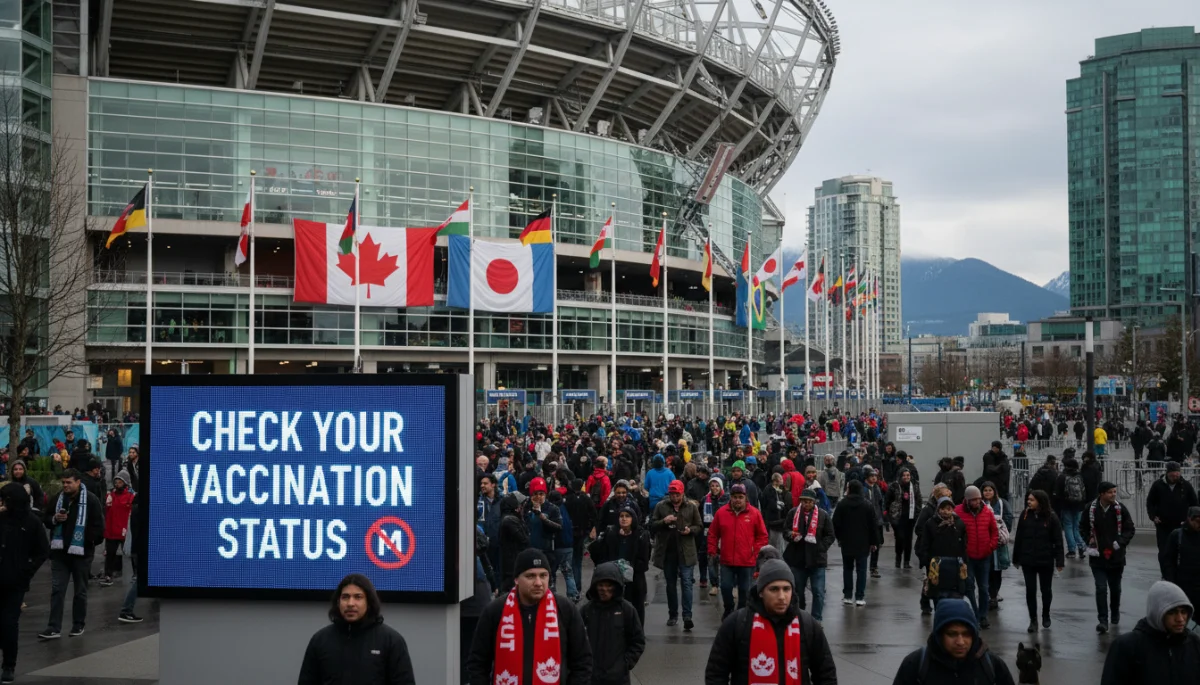
Public health officials are urging caution ahead of next month’s FIFA World Cup in Vancouver, where a steady stream of international visitors could create the kind of conditions that help measles move quickly through a crowd. The concern is not that the tournament will cause an outbreak on its own, but that it may provide a brief window for an imported case to reach people who are not fully protected.
That warning matters because measles remains active in many parts of the world and spreads with remarkable ease through the air. A single infected traveler can expose others in airports, transit hubs, hotels, fan zones, and packed stadiums before anyone realizes the person is contagious. In a setting like the World Cup, where people gather from many countries and move through shared spaces all day, public health teams are paying close attention.
The Public Health Agency of Canada has already flagged measles as one of the diseases most likely to be brought into the country during the tournament. Ontario has gone further by publishing a risk assessment that points to international travel, crowded venues, and falling vaccination rates as factors that could raise the odds of transmission. British Columbia, meanwhile, has not yet released a public version of its own assessment.
Why health officials are paying close attention
Dr. Brian Conway, medical director of the Vancouver Infectious Diseases Centre, says the lack of visible public messaging in B.C. is a problem because awareness itself can reduce risk. His concern is straightforward: when a major event is coming, residents and visitors should be reminded to confirm they are protected against measles before they arrive in a high-traffic city.
Conway says people should check their vaccination history now rather than wait until symptoms appear somewhere in the community. He also believes visitors need to understand that Canada is not dealing with a theoretical threat. Measles is already circulating in parts of the country, which means an imported case could arrive in a place where the virus is not entirely unexpected.
That kind of reminder may sound simple, but it is one of the most practical tools health authorities have. When millions of people are preparing for a global event, clear communication can encourage families, travelers, and even occasional spectators to look up their records and update vaccinations if needed.
Cases are still climbing in Canada
Canada has reported more than 900 measles cases across seven jurisdictions this year, with Alberta and Manitoba accounting for the largest share. The numbers reflect an outbreak that has not yet fully settled, even as some regions have managed to limit local spread.
Last year’s situation was far worse. More than 5,000 people were infected in a much larger surge that began after a case in New Brunswick in fall 2024. That infected person had been exposed outside Canada, showing how quickly one imported case can become a wider national concern when the virus reaches the right conditions.
British Columbia has also seen substantial activity. Provincial data shows 470 measles cases reported across 2025 and 2026, and roughly 80 percent of those infections were concentrated in northeastern B.C., where immunization rates are among the lowest in the province. That pattern is one reason health experts keep returning to the same message: where vaccination is low, measles can find room to spread.
What Vancouver learned from the past
History is another reason officials are not treating this lightly. After the Vancouver 2010 Winter Olympic Games, B.C. recorded a measles outbreak that involved 82 confirmed cases. The circumstances today are different, but the lesson remains the same: a major international sports event can bring together people from many regions and create the sort of contact patterns that infectious diseases exploit.
Conway says the current risk may be higher in some ways because vaccination coverage has slipped in parts of British Columbia. He also notes that some of the countries sending athletes, staff, and fans to the World Cup may have even lower immunization levels than Canada, increasing the chance that a traveler could arrive carrying the virus.
Even so, experts are careful not to suggest that a single case will automatically trigger a large outbreak. The main difference now is that public health teams understand the stakes better and can move quickly if a case is detected. Rapid identification, isolation, and contact tracing are still the core defenses.
Health systems say they are preparing
Vancouver Coastal Health says it has been planning for the tournament for years and has completed a public health risk assessment with the B.C. Centre for Disease Control. The full findings have not been released, but the agency says the work is part of a broader effort to make sure systems are ready for any event-related health concerns.
Dr. Mark Lysyshyn, deputy chief medical health officer with Vancouver Coastal Health, said the assessment placed the measles risk in the medium range. He also pointed out that the region has already handled dozens of imported measles cases during the current outbreak without seeing sustained local transmission.
According to Lysyshyn, high immunization coverage in the Vancouver Coastal Health region has made a meaningful difference. Strong vaccine uptake helps stop chains of transmission before they grow, which means an imported case during the World Cup would not necessarily be harder to manage than other cases health teams have already faced.
The City of Vancouver says its operational and emergency management plans are ready as well. City officials say they are prepared to respond appropriately if public health or safety issues arise during the event, which is the kind of planning large tournaments require even when the most likely outcome is that nothing unusual happens.
Who is most at risk
Dr. Monika Naus, a professor at the University of British Columbia’s School of Population and Public Health, says any large international gathering carries some infectious disease risk. Still, she argues that the overall danger to the general public remains limited because most adults are already immune to measles through vaccination or prior infection.
The greater concern, she says, is not the average attendee but the communities where vaccination rates remain low. If measles reaches those neighborhoods, it can spread much more easily than it would in a well-immunized population. In B.C., those vulnerable areas are often geographically clustered, which can make public health response more challenging.
That is why experts keep returning to the same practical advice: know your vaccination status, especially before traveling, attending crowded events, or hosting visitors. Measles is highly contagious, but it is also vaccine-preventable, which makes prevention one of the few areas where individuals can reduce risk before the first case appears.
Canada no longer holds elimination status
The Public Health Agency of Canada said last year that the Pan American Health Organization notified Canada it had lost measles elimination status. That designation is lost when transmission continues over an extended period rather than appearing only as isolated imported cases.
Canada can regain elimination status if measles transmission is interrupted for a full year. Until then, health authorities will continue treating imported cases as a serious signal, especially when large events, frequent travel, and mixed vaccination coverage increase the chance of exposure.
For Vancouver, the World Cup is expected to be a major celebration. But public health experts say the city’s success will depend not only on logistics and security, but also on whether people take a few minutes now to confirm their vaccine history. In this case, a small step before kickoff could help prevent a far bigger problem later.