
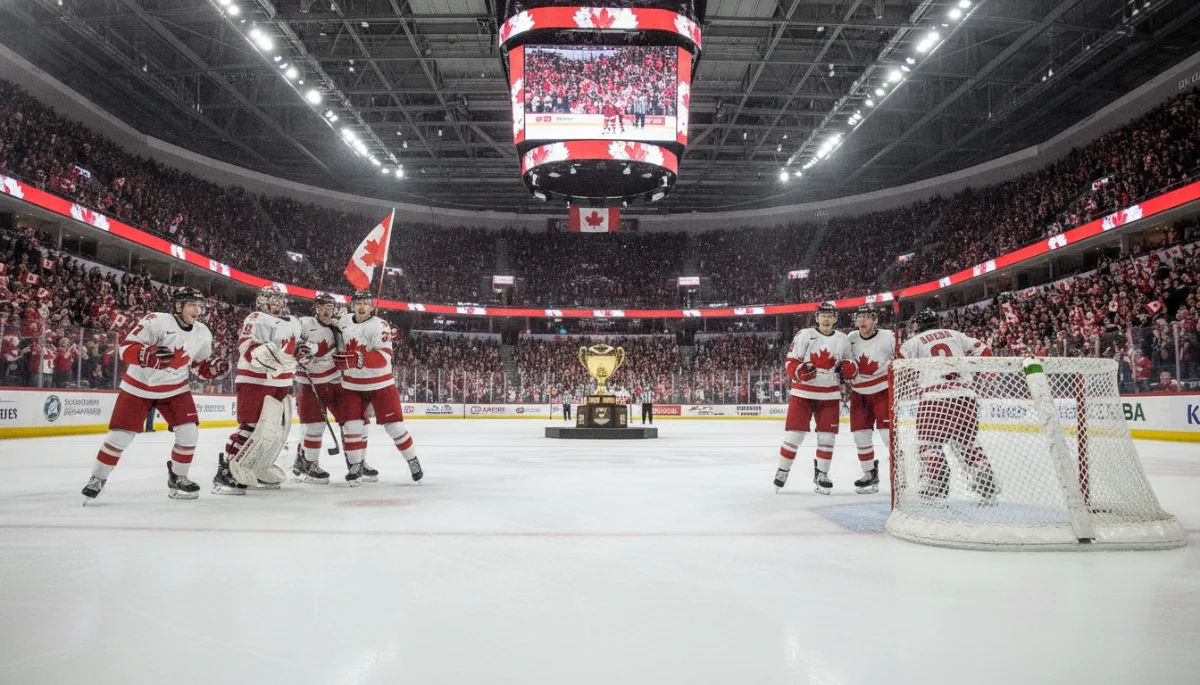
Canada is one win from the 2026 Hlinka Gretzky Cup championship game after cruising through the preliminary round in Edmonton. The host team now turns to Finland in Friday’s semifinal, with a gold-medal matchup against the United States or Slovakia on deck if it keeps winning.
The Canadians have looked fast, deep, and hard to handle, scoring 20 goals in three games while going unbeaten in group play. That offensive output, combined with a home-ice setting at Rogers Place, has made Canada one of the tournament’s clear favorites.
Semifinal timing and what is at stake
Canada and Finland meet on Friday, August 7, 2026, at Rogers Place in Edmonton. The semifinal will decide who moves on to Saturday’s title game and who is left to play for bronze.
| Game | Date | Venue | Local Time | Eastern Time |
|---|---|---|---|---|
| Canada vs. Finland semifinal | Friday, August 7 | Rogers Place | 5 p.m. Mountain | 7 p.m. Eastern |
| Gold medal game | Saturday, August 8 | Rogers Place | 5 p.m. Mountain | 7 p.m. Eastern |
| Bronze medal game | Saturday, August 8 | Rogers Place | Noon Mountain | 2 p.m. Eastern |
Fans can follow the Rogers Place games on TSN and RDS, which are carrying the preliminary round and medal-round action.
How Canada reached this point
Canada opened the tournament with a 7-3 win over Switzerland, and Liam Pue and Brock England each scored twice in that game. It was an immediate sign that the Canadians had scoring spread throughout the lineup rather than relying on one line to do the damage.
The second game was even cleaner. Canada beat Slovakia 6-1, with Kayden Stroeder scoring twice as the hosts took control of Group A. That result set up a showdown for first place in the group, and Canada finished the job with a 7-4 win over Sweden.
The final group game was not as tidy as the first two, but it still showed Canada’s firepower. The team built a five-goal opening period, finished with 49 shots, and held off Sweden’s push before adding late insurance. The record after three games was perfect, and the Canadian attack had already established itself as the tournament’s most dangerous unit.
Possible final opponents
Canada will face the winner of the United States-Slovakia semifinal if it gets past Finland. The Americans and Slovaks play earlier on Friday, and the victor will meet Canada in the championship game.
A Canada-U.S. final would pit the two teams that finished the preliminary round unbeaten. The Americans won Group B by beating Czechia, Finland, and Germany, while allowing only six goals in three games. They also enter the knockout stage as the defending champion after taking the 2025 title.
A final against Slovakia would bring a familiar opponent. Canada already beat Slovakia 6-1 in group play, but the Slovaks still carry threat level because of Tomas Selic, who led the tournament in scoring after the preliminary round with eight points. That kind of production can change a medal game quickly if given space.
What Finland brings to the matchup
Finland reached the semifinals by winning two of its three games, and the path was not simple. The Finns opened with a comeback win over Germany, lost to the United States, then edged Czechia 5-4 to secure second place in Group B.
Goaltender Samu Heikkinen is central to Finland’s chances. He made 38 saves against Czechia and carried a .922 save percentage into the semifinal, one of the best marks among tournament goalies after the group stage. If he sees the puck well early, Canada may have to work much harder than it did in the preliminary round.
Finland is unlikely to dominate puck possession, but it is capable of surviving long stretches without the puck and waiting for mistakes. That means Canada must keep its structure, avoid turnovers, and create traffic in front instead of settling for low-danger shots from the outside.
Players worth watching for Canada
Maddox Schultz has been Canada’s most productive passer so far, finishing the preliminary round with one goal and six assists. His seven points placed him near the top of the entire tournament scoring race, and his ability to create openings for teammates has been a major part of Canada’s attack.
Liam Pue has been the main finisher, scoring four goals and adding two assists. His two-goal night against Switzerland gave Canada an early lift, and his scoring touch around the crease could matter even more against a Finnish goalie who is likely to see heavy pressure.
Kayden Stroeder has matched production with consistency. He scored twice against Slovakia, then added another goal and two assists against Sweden. His pace and ability to contribute in different situations make him one of Canada’s most reliable forwards heading into a tight elimination game.
Landon DuPont has also drawn attention, and not just because of his reputation. The Everett Silvertips defenseman produced one goal and two assists in the opening round, helped drive puck movement on the power play, and showed calm under pressure. He was also the lone player on the 2026 Canadian roster with bronze-medal experience from the 2025 tournament.
Leif Oaten may not face the same shot volume as Canada’s skaters generate, but he still matters. His 2.50 goals-against average through the preliminary round suggests a goalie who can give the team steady work in a game that may tighten up quickly if Finland stays organized.
Why Canada has an edge
Canada’s biggest advantage is balance. Four players sat among the tournament’s top seven scorers after the preliminary round: Schultz with seven points, Pue with six, Stroeder with six, and Ryerson Edgar with five. That kind of spread makes it difficult for opponents to key on one line.
The contribution from the blue line has helped as well. DuPont, Jaakko Wycisk, Brock Cripps, and Alexis Joseph all chipped in offensively, which means Canada can attack from multiple spots and keep pressure on the opposition for a full 60 minutes.
The team’s challenge is not talent. It is control. Canada briefly lost momentum against Sweden after building a huge lead, and penalties allowed the Swedes to claw back with power-play chances. Against Finland, a similar lapse could make a comfortable semifinal into a tense one.
Canada also needs patience. Heikkinen has already shown he can absorb a high volume of shots, so the best approach is to attack with layers, look for rebounds, and make life difficult at the top of the crease. If Canada keeps its discipline and stays direct, it should have a strong path to Saturday’s final.
A chance at another gold
Canada entered the event chasing its record-extending 26th summer under-18 gold medal, and the opening round suggested that goal is realistic. The program has won 25 of the 34 golds awarded since the tournament began in 1991, and its most recent championship came in Edmonton in 2024.
The road is still short but demanding. Finland is the only obstacle standing between Canada and the final, and the winner of Friday’s semifinal gets the chance to play for gold in front of the home crowd on Saturday night.