
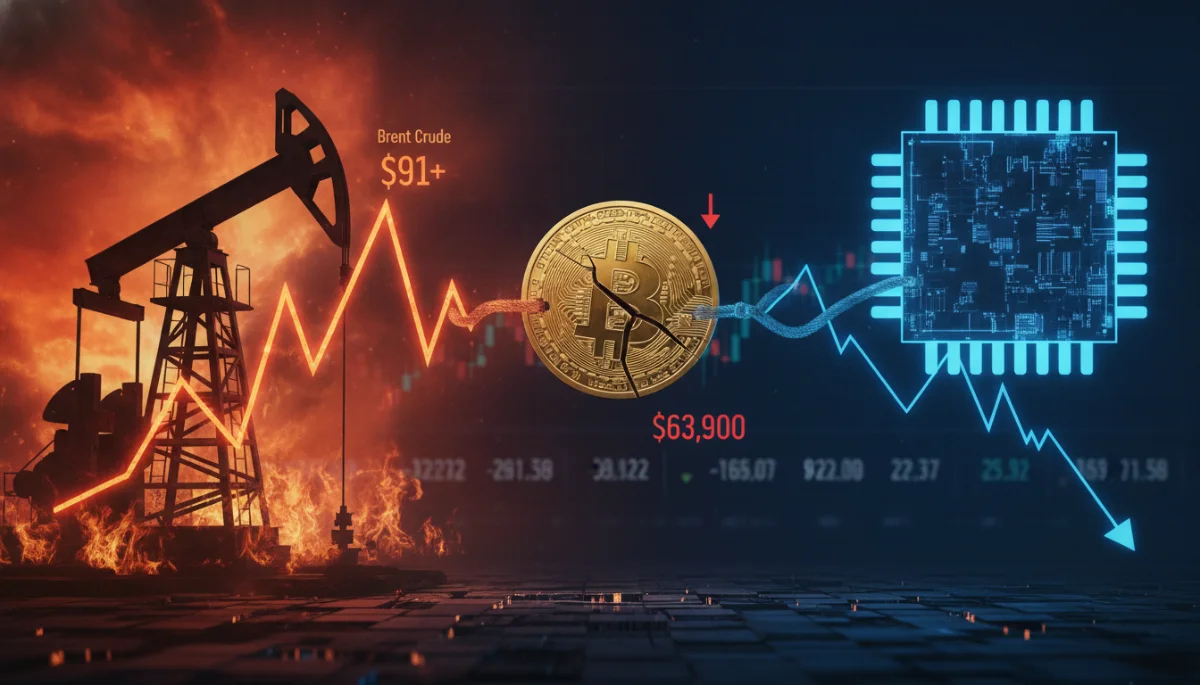
Market Turbulence: Oil Prices Climb While Tech Stocks Fall
Bitcoin plunged below the **$64,000** threshold on July 20, 2026, dropping to approximately **$63,900** as conflicting economic forces squeezed speculative assets . The cryptocurrency market is currently navigating a dangerous “triple headwind” involving macroeconomic caution, inconsistent institutional demand, and sector-specific weakness in technology . Two primary drivers are fueling this downturn: a sharp rally in oil prices due to geopolitical conflict and a continued selloff in the AI technology sector. The energy market is reacting aggressively to escalating strikes between the United States and Iran. Brent crude oil surged past **$91 per barrel**, marking its highest level in a month and reigniting fears of renewed inflation . Historically, rising energy costs act as a catalyst for broader inflationary pressure, which often forces investors to retreat from riskier assets like cryptocurrencies. This dynamic is compounding the pressure on Bitcoin, which is already facing headwinds from the tech sector. Simultaneously, the artificial intelligence sector is experiencing a significant correction. Disappointing earnings and growth forecasts from major Asian chip manufacturers, particularly in South Korea, have triggered a widespread selloff . The South Korean Kospi index fell **3.5%**, signaling that the negative sentiment is spreading beyond individual stocks to the broader technology ecosystem. Since cryptocurrencies are often viewed as high-beta tech assets, the AI downturn is creating a sentiment spillover that exacerbates Bitcoin’s decline.
- Oil Rally: Brent crude exceeded $91/barrel due to U.S.-Iran tensions, sparking inflation fears.
- AI Selloff: Weak earnings from Asian chipmakers caused a 3.5% drop in the Kospi index.
- Macro Caution: Investors are hesitant ahead of the Federal Reserve meeting and amid geopolitical uncertainty.
Shaurya Malwa, a Crypto Market Analyst at Bullish Inc., noted that Bitcoin’s dip reflects a “tug-of-war” between inflation anxieties driven by oil and the tech sector’s instability . Investors are currently positioning their portfolios cautiously, waiting for clearer signals on the macroeconomic front.
Cryptocurrency Price Performance and Key Data
The downturn was not limited to Bitcoin; the broader cryptocurrency market experienced modest declines across major tokens. **Ethereum (ETH)** softened by 1.1% to trade at **$1,850**, while **Binance Coin (BNB)** and **XRP** also saw slight decreases . A notable underperformer in this session was Hyperliquid’s **HYPE** token, which suffered an **8.0%** weekly loss, highlighting specific volatility within certain sectors of the market . The following table details the price performance of key cryptocurrencies as of July 20, 2026:
| Cryptocurrency | Price (July 20, 2026) | 24h Change | Weekly Change |
|---|---|---|---|
| Bitcoin (BTC) | $63,900 | -1.3% | +2.0% |
| Ethereum (ETH) | $1,850 | -1.1% | — |
| Binance Coin (BNB) | $564 | -0.8% | — |
| XRP | $1.09 | – | — |
| Dogecoin (DOGE) | — | -1.4% | — |
| Hyperliquid’s HYPE | $60 | — | -8.0% |
Dr. Linda Chen, an economist from the Global Economic Forum, explained that inflationary concerns stemming from geopolitical conflicts typically prompt investors to shift away from riskier assets, driving price corrections . The correlation between tech stock performance and crypto movements remains strong, as investors reassess their exposure to technology innovation across the board, including blockchain assets .
Geopolitical Tensions and ETF Sentiment
The root of the current inflation fear lies in the **U.S.-Iran conflict**, which has disrupted energy markets and raised the specter of higher interest rates. When oil prices climb, the expectation of “higher-for-longer” interest rates increases, which directly dampens the risk appetite necessary for crypto markets to thrive . This geopolitical instability is a primary factor in Bitcoin’s failure to hold above the $64,000 resistance level. Despite the negative price action, **Bitcoin ETFs** have recorded small inflows recently, suggesting that some institutional investors view these lower prices as a buying opportunity . However, CoinDesk Research describes these inflows as “peanuts” relative to the recent exodus, indicating that investor confidence remains fragile . The market is currently characterized by a fragile recovery losing momentum rather than a full-blown crash, though the risk of further downside remains if macroeconomic conditions worsen . Investors should monitor three critical factors in the coming days:
1. **Geopolitical developments** regarding the U.S.-Iran situation and oil prices.
2. **Inflation data** releases that could influence Federal Reserve policy.
3. **Tech sector trends**, specifically earnings reports from AI chip manufacturers. The volatility inherent in cryptocurrencies is expected to persist until clear signals emerge regarding inflation stability and tech sector recovery. While Bitcoin still holds a modest weekly gain of 2.0%, the immediate trend is bearish as the market grapples with these dual pressures of energy inflation and technological uncertainty .