
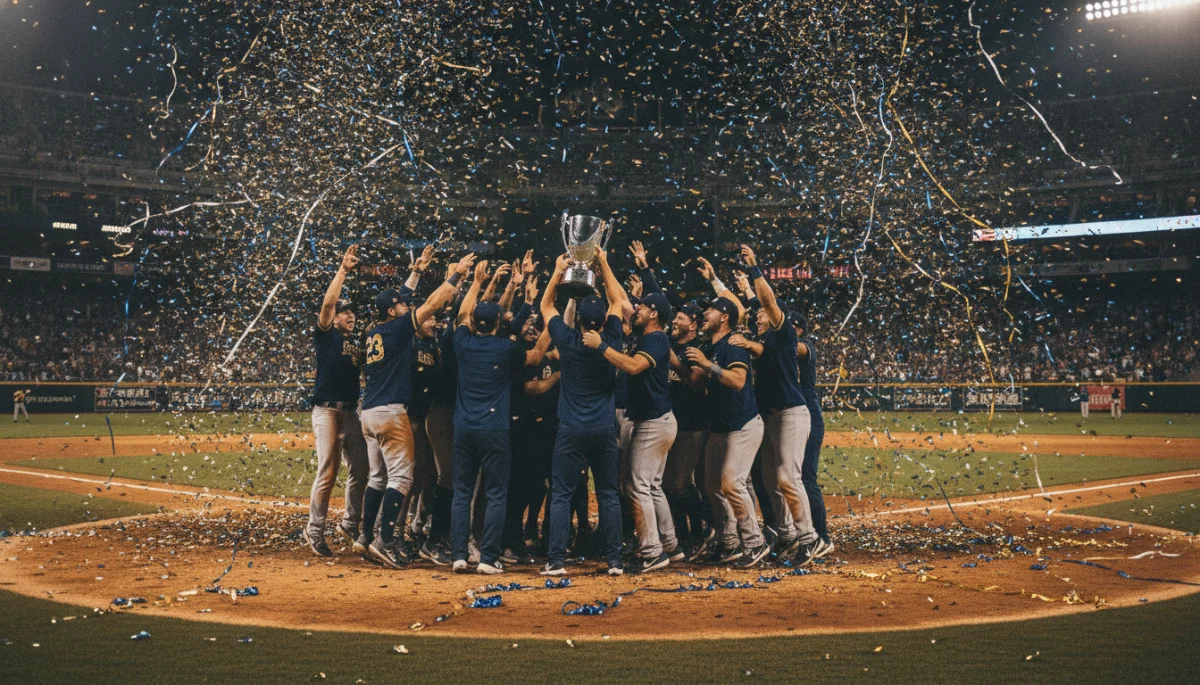
The Milwaukee Brewers have ended a 44-year wait for another World Series appearance. A four-run comeback at Dodger Stadium produced a 6–4 victory over the Los Angeles Dodgers in Game 4 of the National League Championship Series, completing a stunning four-game sweep of the two-time defending champions.
Milwaukee will open the World Series on October 23, with Game 1 scheduled for FOX. The franchise now stands four victories away from its first championship.
A Comeback That Changed the Series
The Dodgers entered the NLCS with the kind of star power and home-run threat that usually defines October baseball. Instead, Milwaukee repeatedly found ways to create pressure, respond to adversity and make the decisive play. Across the four games, the Brewers hit seven home runs to Los Angeles’ one.
Game 4 captured the entire series in a single night. The Brewers fell behind by four runs, but their offence refused to disappear. Garrett Mitchell’s solo homer in the sixth inning broke the tie and gave Milwaukee the lead, while David Hamilton launched a ninth-inning insurance shot that made the finish more comfortable.
- Mitchell delivered the go-ahead blast when the game was still in doubt.
- Hamilton’s late homer added valuable separation.
- The bullpen protected the advantage through the final outs.
- Jackson Chourio tracked down the last deep fly ball near the left-field warning track.
Chourio’s catch brought the celebration into focus. Brewers radio broadcaster Jeff Levering, who previously shared the booth with the late Bob Uecker, announced that Milwaukee had won the pennant and that the World Series would be coming through Wisconsin.
The 1982 Echoes Finally Have a Sequel
For generations of Brewers supporters, the club’s only previous World Series trip had remained frozen in 1982. The famous final play from that season has also been surrounded by a long-standing misunderstanding.
Many fans have attributed the iconic pennant call to Uecker. However, Uecker had left the broadcast booth late in Game 5 of the American League Championship Series to go to the clubhouse and prepare for the radio celebration. When Rod Carew hit a ground ball to Robin Yount, and Yount threw to Cecil Cooper for the final out, it was broadcast partner Dwayne Mosley who told listeners that Milwaukee had reached the World Series.
The wait that followed lasted more than four decades. Several promising Brewers teams came close, but none had managed to recreate the breakthrough of the early 1980s. Thursday’s clincher therefore carried more than the significance of an ordinary pennant: it connected a new generation with one of the defining moments in franchise history.
Yelich and Milwaukee Finally Solve the Dodgers
Christian Yelich has experienced the frustration of postseason defeats against Los Angeles from several different angles. The Dodgers helped end Milwaukee’s 2018 NLCS run, contributed to another postseason disappointment in 2020 and swept the Brewers in the 2025 NLCS.
The latest defeat had come only about a year earlier, when Yelich stood in the visitors’ clubhouse after Milwaukee’s four-game elimination. The veteran hitter continued to argue that each season should be judged on its own terms, even while acknowledging that the new team had a different character.
That belief became especially meaningful after Milwaukee named Yelich its captain. As the longest-serving hitter on the roster, he represented the organization’s modern era while also carrying the memory of earlier near-misses. After the sweep, he pointed to the clubhouse’s trust and its refusal to doubt the possibility of finishing the job.
For the first time during his Brewers career, Yelich will play in the World Series. The victory also gives Milwaukee a measure of revenge against the opponent that had repeatedly blocked its path.
An Unusual Offence Powers an Historic Season
This is not a team built in the image of the 1982 Brewers. That club was known as “Harvey’s Wallbangers” after leading the majors in home runs. The 2026 roster took a far less conventional route during the regular season.
Milwaukee ranked near the bottom of baseball in home runs, yet finished second in total runs. The offence depended on difficult at-bats, movement on the bases and constant pressure rather than simply waiting for one swing to change the scoreboard. Outfielder Sal Frelick described the approach as wearing pitchers down until every inning became uncomfortable.
The sudden power surge against Los Angeles made the pennant even more surprising. A team that had won through contact and persistence matched the Dodgers’ biggest strength when the stakes were highest. Mitchell and Hamilton supplied timely power, but the broader success still came from a lineup that consistently extended innings and forced mistakes.
Milwaukee’s postseason record reflects that resilience. The Brewers became the first team in baseball history to win six comeback games during the opening eight games of a post-season run. They did not simply dominate from the front; they repeatedly recovered when the situation appeared to turn against them.
Numbers That Put the Achievement in Perspective
The Game 4 win was Milwaukee’s 110th victory in its 170th meaningful game of the 2026 campaign. The total includes a regular season unlike any in franchise history, followed by two decisive playoff series.
- The Brewers won 103 regular-season games, setting a club record and posting the best record in the majors.
- They won three games in the Division Series against San Diego, a club that had owned baseball’s strongest record after the All-Star break.
- They defeated Los Angeles four times without a loss in the NLCS.
- They became the first team in 103 years to lose a post-season series by sweep and then sweep that same opponent the following October.
The accomplishment is particularly striking because Milwaukee had suffered a sweep against the Dodgers only one year earlier. Instead of allowing that result to define the organization, the Brewers returned with a stronger collective identity and reversed the matchup completely.
From Rebuilding Doubts to National League Champions
The club’s rise also carries a strong organizational story. Staff members still remember a cake delivered to the front desk at the former Miller Park after the team won two games in early May during a difficult period. The blue-frosted message congratulated Milwaukee for no longer being the worst team in baseball.
The gesture arrived after a stretch that included a second-half collapse in 2014, a managerial change early in 2015 and considerable turnover in both the roster and the front office. At the time, even modest improvement could feel significant. The pennant now stands as a dramatic answer to those years of uncertainty.
Assistant general manager Karl Mueller joined the Brewers in 2004 as one of Ned Yost’s analytically inclined scouting assistants, working from VHS footage. He said the championship-series victory was difficult to absorb because the organization’s turnaround had unfolded gradually rather than through one sudden transformation.
Over the past 10 regular seasons, only the Dodgers, Astros and Yankees have posted better winning percentages than Milwaukee. Since Pat Murphy took over as manager three seasons ago, no team has won more often. President of baseball operations Matt Arnold recognized the importance of the pennant but immediately stressed the need to maintain focus before the World Series begins.
Why the Number 44 Feels Significant
After Milwaukee won Game 3, owner Mark Attanasio called franchise founder Bud Selig at 10:50 p.m. Central time. Selig, 92, was too energized to sleep and repeatedly described the club as remarkable.
Attanasio’s ownership group bought the Brewers before the 2005 season, following the franchise’s 12th consecutive losing campaign. A .500 record in that first year felt like a major breakthrough. The 2008 Wild Card, which ended a 26-year playoff absence, felt even larger.
The 44-year gap also carries a connection to Hank Aaron, who wore No. 44 during his time in Milwaukee and hit the final home run of his 755-homer career 50 years ago. Aaron and Uecker later helped advocate for Miller Park, an effort that supported the Brewers’ place in Wisconsin and in Major League Baseball’s smallest media market.
Attanasio saw several moments during this postseason as signs that the season might be different:
- Ty France hit a ball that glanced off the roof before landing in Chourio’s glove during NLDS Game 1.
- Mitchell made a difficult catch on a deep Manny Machado drive to finish the Division Series.
- Jake Bauers, who chose not to retire in 2024 after his wife became pregnant, produced a breakthrough season at age 30 and delivered several major NLCS at-bats.
- Milwaukee repeatedly won after falling behind, establishing a post-season comeback pattern unlike anything the franchise had previously achieved.
Supporters Followed the Team Across the Continent
Brewers fans filled sections of Dodger Stadium and remained in place to watch the team receive the Warren C. Giles Trophy. Some supporters travelled to Los Angeles on almost no notice because missing the clincher was not an option.
Joe Stolarczyk watched Game 3 at Hog Creek Bar & Grill in Mosinee. Around 1 a.m., he decided to fly to Los Angeles. His brother David Stolarczyk and sister Mary Pilz joined him after friends failed to answer their phones. The group bought tickets while travelling towards a Minneapolis flight and reached seats behind home plate before batting practice ended. Joe had been living in Alaska during Milwaukee’s 1982 run.
Longtime friends Dave Wuest of Atlanta and Murray Williams of Orange County also attended. They have known each other since kindergarten and still remember the disappointment of Milwaukee’s 1982 Game 7 loss to the Cardinals.
Yelich described the travelling crowd as electric. The Brewers will need that same energy when the World Series comes to Wisconsin, where a club once mocked for modest progress now has the opportunity to win the first championship in its history.