
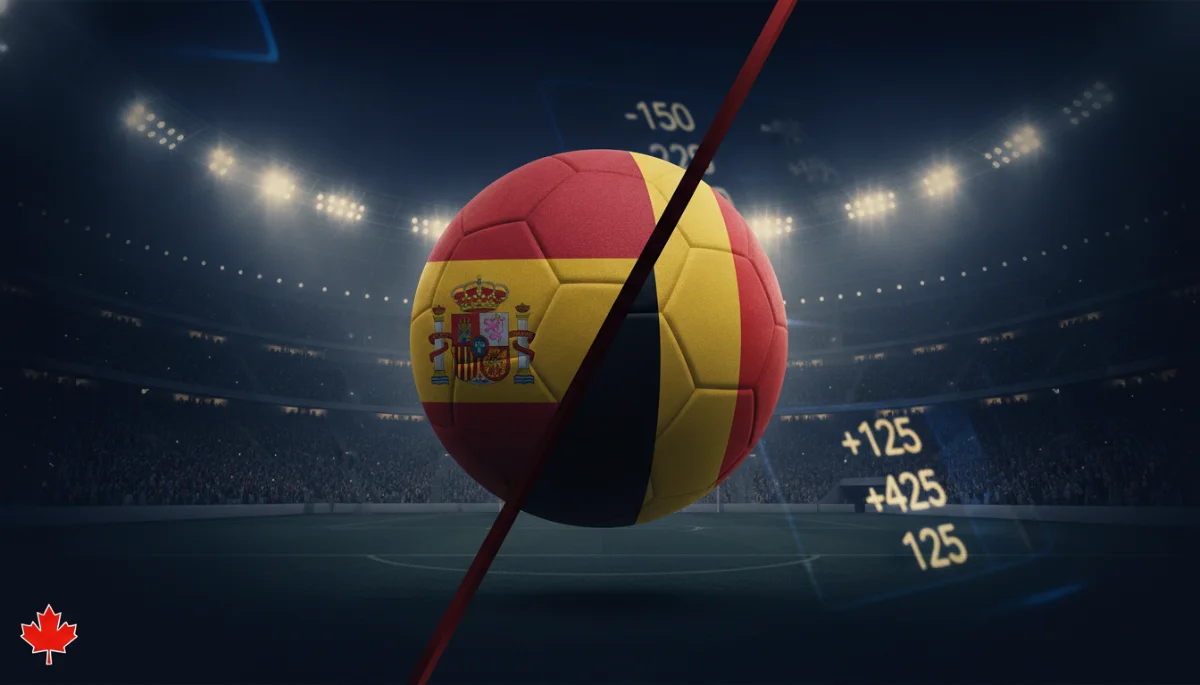
Friday, July 10, 2026 — SoFi Stadium, Inglewood, California
Six years after Belgium’s golden generation fell one round short of a World Cup final, and eight years after Spain’s own quarterfinal heartbreak, these two European giants meet again with a semifinal spot on the line. This matchup offers bettors real texture: Spain holds the tournament’s best defensive record, while Belgium just knocked out co-host United States 4-1 and rides an 18-match unbeaten streak. For Canadian bettors weighing how or whether to get involved, here is the breakdown.
Who Should Read This Guide
This is not a “lock of the century” pitch. It serves different bettor types, so identify your camp before placing anything:
- The cautious favorite-backer who wants exposure to the stronger team without paying a huge price, preferring a handicap line over a straight moneyline.
- The low-scoring specialist who noticed Spain has not conceded a goal all tournament and wants to build a bet around that trend rather than the match winner.
- The prop and parlay player who prefers stacking same-game combinations—like a scorer, a card, and a result—for a bigger payout on a smaller stake.
- The underdog or value bettor who knows Belgium has Kevin De Bruyne and a knockout-round win over the Americans, and wants a live long shot rather than backing the chalk.
- The first-time World Cup bettor who needs help understanding what these bet types even mean before deciding where their money should go.
If you do not see yourself in those groups, that is fine. The point is that “who should bet this game” depends entirely on what kind of risk you carry, not on a single “right” pick.
The Tactical Battle
Spain arrives unbeaten through the group stage and knockouts, anchored by a defense analysts flag as the tournament’s best. Reports indicate Spain conceding at roughly 0.05 expected goals per shot faced, with only a handful of shots on target allowed across their first five matches. Historically, the head-to-head tilts heavily toward La Roja: Spain holds five wins in a row against Belgium dating back to 2004, including previous World Cup meetings.
Belgium is not without weapons. De Bruyne remains capable of unlocking a low block from deep positions, and Belgium scored freely against the U.S. in the round of 16. However, the team faces a significant absence in midfield: Amadou Onana is reportedly out with an ACL injury, a real blow to Belgium’s ability to press and control central areas against Spain’s possession game. Zeno Debast’s fitness is also questionable, while Spain monitors winger Nico Williams.
What the Consensus Predicts for the Score
There is no single “official” score, but pulling from multiple previews, the consensus shape is consistent:
- Most likely outcome: A narrow Spain win, with previews leaning toward 1-0 or 2-0 rather than a blowout. One outlet explicitly called Spain 2-0.
- Total goals: Several previews lean toward Under 2.5 goals, built around Spain’s defensive record rather than an expectation that Belgium cannot score at all.
- Clean sheet angle: More than one preview highlights Spain’s streak of consecutive clean sheets this tournament as the single biggest data point; that is the trend “under” and “Spain to win to nil” bets hang on.
- Handicap view: Coverage citing a Spain -1 Asian handicap price suggests the market expects Spain to win by more than a single goal often enough to make that line a coin flip, not a lock.
Treat all that as a synthesis of public analysis, not a guarantee. Nobody has a verified crystal ball for a knockout match between two well-matched federations, and Belgium has already shown it can produce a result nobody expected against the U.S.
Odds and What They Mean for Canadians
Canadian sportsbooks typically show you a choice of odds format (decimal, American, or fractional) in your account settings. Decimal is the default in most of the market and the easiest for quick math (stake × decimal odds = total payout). Lines move in the run-up to kickoff and will keep moving, so treat the following as a snapshot rather than what you will see the moment you open your app:
Match winner (90 minutes) in American format: Spain sits between -150 and -165, the draw ranges +290 to +317, and Belgium sits +425 to +488. In approximate decimal form, these translate to Spain ~1.61–1.67, the draw ~3.90–4.17, and Belgium ~5.25–5.88. To advance (including extra time and penalties), Spain is priced at -340 (~1.29 decimal) while Belgium is +260 (~3.60 decimal). For total goals, Over 2.5 runs ~-117 to -125, while Under 2.5 runs ~+100 to +113.
Some same-game prop lines worth noting include Mikel Oyarzabal to score anytime at around +120 (~2.20 decimal) and Lamine Yamal anytime scorer at -120 (~1.83 decimal). One widely cited bet builder—Spain to win in 90 minutes, Oyarzabal to score, and Nicolas Raskin to be carded—was priced at roughly 6/1 (about 7.00 decimal) with one UK bookmaker.
Always confirm live odds in your own sportsbook before betting. These numbers came from previews published in the days before kickoff and will have shifted, sometimes significantly, especially once starting lineups are confirmed.
Matching the Bet to Your Style
If you are a cautious favorite-backer, a straight Spain moneyline pays little given how short the price is. If you want Spain but better value than the moneyline, an Asian handicap (Spain -1) or a draw no bet on Spain gets you a more competitive number while still backing the favorite. If you are a low-scoring specialist, Under 2.5 total goals is the bet most previews converge on, built directly around Spain’s tournament-long defensive numbers. Combining it with “Spain to win and both teams not to score” is a more specific version of the same read.
For prop or parlay players, anytime goalscorer markets (Oyarzabal, Yamal) and same-game bet builders let you express a view on how the game plays out, not just who wins. This is useful if you think Spain wins but want a bigger multiplier than the straight moneyline offers. Underdog or value bettors should consider Belgium moneyline or Belgium/Draw double chance as the highest-variance route; you are betting that De Bruyne creates enough against a defense that has not been breached yet, banking on the same unpredictability that beat the U.S.
First-timers should start simple. A small stake on the match-winner market or a total-goals over/under is easier to track and understand than a multi-leg bet builder, even if the payout is smaller.
Key Housekeeping Notes
Age limits vary by province. The legal minimum is 18 in Alberta, Manitoba, and Quebec, and 19 in Ontario, British Columbia, and most other provinces. This is entertainment, not an investment. Nothing above is a guaranteed outcome. It is a synthesis of public previews and market pricing, and knockout football has a well-earned reputation for humbling favorites (Belgium’s own run to this point is a good example).
Bet what you can afford to lose. Set a limit before kickoff rather than during it, and treat in-play chasing as the fastest way to turn a bad beat into a worse one. If gambling stops being fun, free, confidential support is available across Canada: ConnexOntario (1-866-531-2600) for Ontario residents, GameSense through BCLC in British Columbia, Jeu: aide in Quebec, and equivalent provincial programs elsewhere.
Whatever side of this one you land on, it is shaping up to be one of the more tactically interesting quarterfinals of the tournament. Rodri’s control of midfield against De Bruyne’s ability to break lines from deep is a genuine chess match, independent of what you have riding on it.
Odds and predictions referenced above reflect previews published in the days before the July 10, 2026 kickoff and are for informational purposes only; they will differ from live odds at any given sportsbook. Not financial advice — gamble responsibly.